To benchmark against international advanced standards and grasp overseas market demand, the company officially launched field research for overseas market expansion, choosing South Korea as the first stop to conduct in-depth study of local modern protected agriculture models, cultivation technologies and vegetable market supply and demand, accumulating first-hand experience for its products going global.
Choosing South Korea as the first stop for overseas research involves both geographic and industrial considerations, as well as real market logic: South Korea’s protected agriculture started early with high standards, making it an ideal sample for domestic companies to test product competitiveness and benchmark against international levels; at the same time, South Korea and China are highly complementary in agricultural equipment and technical cooperation — both a learnable benchmark and an explorable market. Placing the first stop in South Korea helps the company complete a high-intensity “reconnaissance and calibration” before formally going global.
South Korea has limited arable land resources, with per-capita arable land of only about 0.03 hectares, and a severely aging agricultural population — practitioners aged 65 and above account for more than half. Facing production pressure from labor shortages and climate change, South Korea has elevated the development of smart agriculture to a national strategy: in 2024 it enacted and implemented the Act on the Promotion of and Support for Smart Agriculture, giving smart agriculture dedicated legal protection for the first time; in February 2025, based on this act, it formulated and promulgated the First Basic Plan for Smart Agriculture Promotion (2025–2029), explicitly targeting the conversion of 35% of the nation’s 55,000 hectares of greenhouses into smart farms, and promoting at least one smart agriculture technology in major field crop production areas. According to government planning, the smart agriculture adoption rate will rise from 16% in 2024 to 35% by 2030.
South Korea’s smart agriculture advancement presents a clear path of “legislation first, planning support, demonstration-driven.” Under the guidance of laws and plans, the government uses subsidies, finance and digital infrastructure to guide farmers and agricultural companies to accelerate intelligent upgrading; meanwhile, South Korea started early in facility horticulture environmental control, automated operations and data applications, forming a relatively complete industrial ecosystem — both a benchmarking target and a potential source of cooperation.
During the research, we visited local smart greenhouses and plant factories, gaining on-site understanding of their environmental control systems, soilless cultivation processes and post-harvest handling workflows, and exchanged views with cultivation companies, equipment suppliers and industry organizations on technical routes, cost structures and operating models. South Korea’s protected agriculture experience in refined management, standardized production and branded operation left a deep impression on us.
During the visits, the company team focused on the energy efficiency management and crop output efficiency of South Korean plant factories and smart greenhouses: through closed-loop control of environment-nutrition-light, yield per unit area and resource utilization improved significantly, while standardized workflows also reduced dependence on experience-based labor. These practices are highly consistent with the design philosophy of the container-type smart cultivation cabin, providing a reference sample for the company to optimize the cabin’s energy efficiency ratio and automation level.
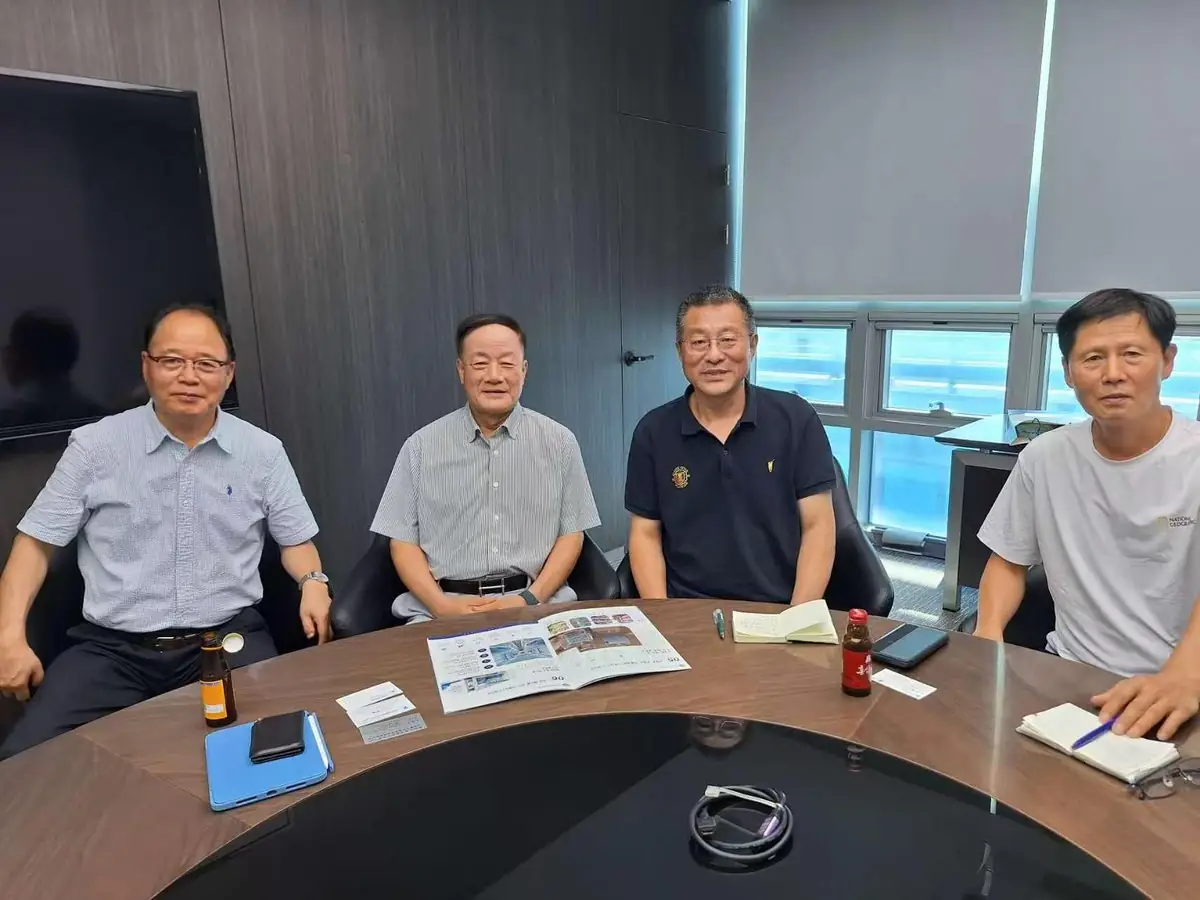
▲ Discussion and exchange with Korean cultivation companies and industry organizations during the research
Notably, South Korea has also built a nationwide farmer training network: since 2018, the Rural Development Administration has successively established smart farm experimental training centers, providing farmers with practical training in facility control, crop management and data analysis to help traditional growers transition to smart agriculture. Between 2019 and 2023, more than 68,000 people participated in related training, with farms adopting smart agriculture technology seeing average productivity increase by 23% and income increase by 22%. This approach of advancing technology and talent in sync is equally worth learning from.
South Korea’s experience of advancing “technology + talent” in sync also inspires the company to place greater emphasis on localized service capability building in its going-global process. Next steps, beyond product and technical alignment, include building an overseas customer support system around operation training, remote operation and maintenance, and spare parts supply, so that the cabins are not only “usable” but also “well-used and well-managed,” truly integrating into local agricultural production systems.
At the same time, we systematically reviewed the variety structure, price trends and import dependence of the local vegetable market, clarifying our products’ comparative advantages in water savings, land savings and rapid deployment. This research provides an important reference for the company’s overseas layout: we must both build strong internal capability in advanced technology and find the right market entry path. Next, the company will translate the research findings into concrete product and solution improvements, steadily advancing overseas market expansion.